Memories Of Martin Parr - A guest post written by Bob Pegg
Updated: Sep 11
I was aware that Bob Pegg, a resident of Scotland and an esteemed subscriber to my newsletter Get Inspired, used to live in Hebden Bridge and worked with photographer Martin Parr here in the 1970s. Following Martin's death I asked Bob if he would be willing to share a first-hand account of that time and this is his fascinating contibution:
MEMORIES OF MARTIN PARR
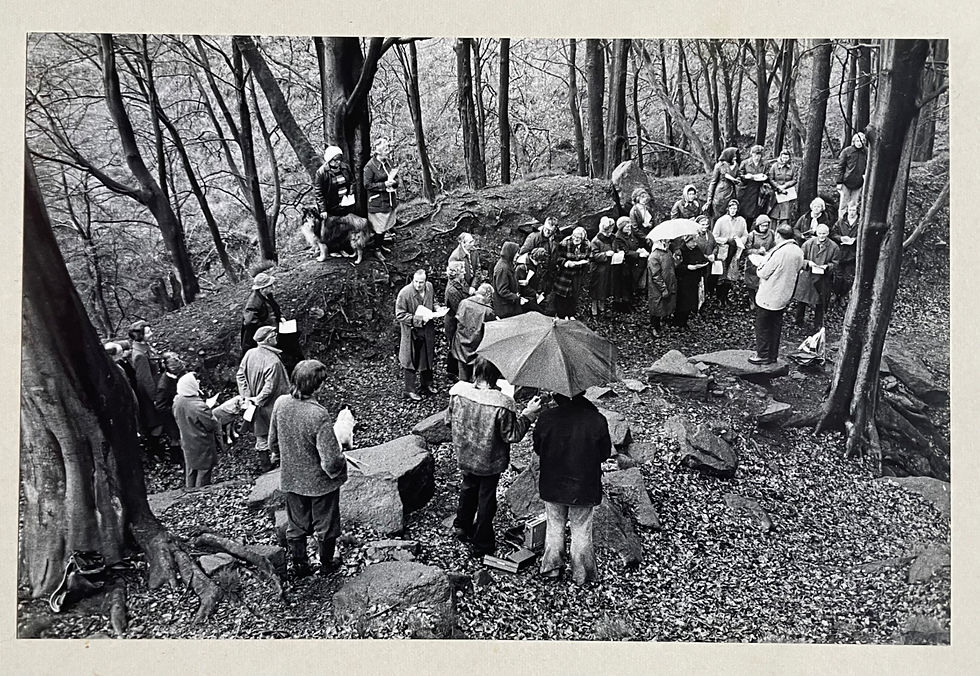
This photograph of a woodland gathering was taken by Martin Parr early in the morning of 2nd May 1976. Standing on the flat rock to the right, Ted Matkovich, a Methodist minister, preaches to a congregation in the Praying Hole, a spot on the northern side of the precipitous Colden Valley, to the west of Heptonstall. John Wesley, the leading founder of Methodism, is said to have stood on the same rock to preach, when he visited the area in the middle of the 18th century.
The right-hand of the two figures beneath the umbrella, mid-centre, I am making a sound recording of the proceedings (on the ground are the Uher Report reel-to-reel tape recorder, and two oblong microphone boxes). The figure in the left foreground, in wellingtons and a knitted jacket, and closest to the camera, is Susie Mitchell. A few years later, Susie would marry the photographer.
Many of you reading this will know that Martin died very recently, just a few weeks shy of Christmas 2025, at the age of 73. By the end of his life he was renowned world-wide, primarily for the bold, burnished colour photos he began taking in the 1980s, and more recently as a champion of photography and photographers through the work of the Martin Parr Foundation in Bristol.
When he took this picture of the Praying Hole he was just a lad, not long out of Manchester Polytechnic, one of an increasing number of young, creative people who at the time found Hebden Bridge and its environs - the proximity of moorland to the town’s eccentric architecture - both inspiring and cheap to live in.
Working in black and white, Martin was lovingly exploring the last vestiges of interwoven ways of life - agricultural, industrial, religious - whose roots stretched back into Victorian times and before; and, in particular, the rapidly-declining communities of the chapels: their anniversaries, harvest festivals, and the intricate details of their everyday lives. Those images are now celebrated, and much reproduced; a wintry Hebden lit up like a Christmas tree; the convocation of Henpecked Husbands; Crimsworth Dean Methodist Chapel, a haven glowing with inner light amid nocturnal mists.
Martin and I met by luck and good fortune. In 1975 I was employed by the Arvon Foundation to record the memories of older generations of people living in the area around Hebden Bridge. With my family I moved from Leeds to the tiny cottages next to Lumb Bank, the Foundation’s northern base, on the north slopes at the mouth of the Colden Valley. I was looking for contacts in the local community, and someone said, “Martin Parr’s your man.” Martin and Susie - already a team - introduced me to the people whose lives they’d been documenting.
In particular I recall the wonderfully gossipy Willie Sutcliffe, lay preacher and maître d’ of the restaurant he ran with his brother Harold in their old family home (Harold did the cooking); with a set three-course dinner of solid traditional food, and bring your own bottle if you wished (as Methodists they couldn’t countenance being licensed), they were booked up for months ahead. Most memorable of all was when Martin and Susie took me to visit the remote Thurrish farmhouse of Charlie and Sarah Hannah Greenwood, way up Crimsworth Dean on the old Keighley Road, where the elderly brother and sister lived as their parents had done, walls lined with photos of deceased relatives, the insides of the picture frames fringed with old funeral cards.
Martin, a lanky youth eight years younger than me, already possessed the characteristics that distinguished the older Parr: affable and equable, effortlessly hardworking, dedicated to whatever the present task might be (however small), quietly surprised by the funny ways in which people carried on, and wryly pronouncing on whatever might be tickling him at that particular moment. If you wanted to locate him in a room full of people you only had to listen out for the laugh, a gravelly guffaw, as distinctive as the call of a corncrake hiding in a field of high grasses.
We eventually became neighbours in Birchcliffe in Hebden Bridge, and there was a fair amount of popping in and out of each other’s houses, just keeping up and hanging out.
Then, in 1978, we found ourselves working together on an exhibition that would be mounted in the Tourist Information Centre, which at that time was on the corner of Bridge Gate and West End.
We’d both noticed that many of the older residents had drawers where they kept stashes of old photos, often duplicated from one household to another: a team of horses hauling a miniature steam locomotive up the hill to Heptonstall; workers posing on the bowling green in front of a mill; Timothy Feather (a favourite), the “last handloom weaver” from Stanbury. The photos were a shifting kaleidoscope of communal memories. Some, like the one of the bowling green (it was of Lower Lumb Mill in the Colden Valley, taken around the turn of the 20th century), showed a working mill that, by 1978, had long been reduced to a single standing chimney. Timothy Feather’s image had been copied and re-copied so many times that, in one version, the features of his face were entirely obliterated, and someone had attempted to recreate them in pencil.
In our plan for the exhibition, visitors would be able to listen to an edited recording of local voices, while looking at photographs that were mounted on card and fixed to the walls with drawing pins. Martin prepared all the photos in the same format, though their provenance differed. Some were copies of those treasured “drawer” images from people’s homes. Otherwise they were his own work - either echoing a scene from the past to show how it now looked at the time of the exhibition (a mill reduced to a chimney), or entirely original shots of foliage and ruin, taken in abandoned locations where the owners of the voices on the tape had once lived and worked. The photo of the Praying Hole is the only contemporary image from the exhibition to include people (and dogs).
The exhibition’s opening coincided with the launch of a book, a beautiful little softback produced and published by Tony Ward, whose Arc and Throstle Press at the time occupied a building (originally, I think, the coach house) at the far end of the Lumb Bank courtyard. Appropriately entitled Memories, the book was the memoir of Harry Greenwood, edited from his original text, which he had handwritten in an old ledger. Harry was a retired farmer who answered to no-one. He was said to be very wealthy, though he lived austerely, alone in a two-up two-down terrace house at Edge Hey Green, on the road between Heptonstall and Jack Bridge.
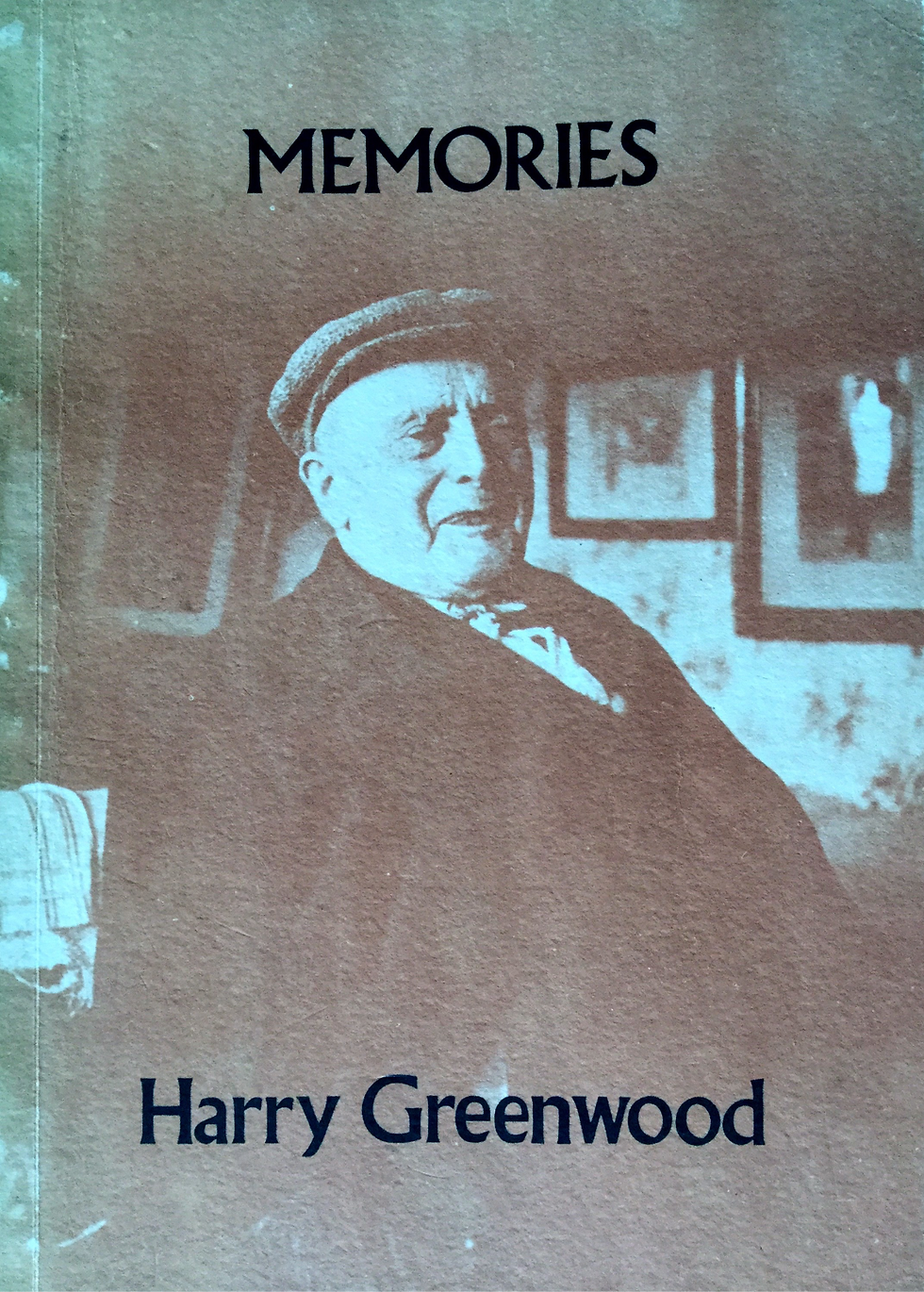
Harry had been invalided out of World War I with heart trouble, and told to take life easy. He’d followed this advice with great success and was now well into his eighties. Martin, who later became well-known for grumpily discouraging his subjects from smiling for the camera, took Harry’s portrait for the cover of Memories, and captured the cheeky grin of a man who had stared death in the face, and told him to bugger off.
The exhibition went well. Harry’s book sold out, and the Information Centre doubled the number of visitors they would normally expect for that time of the year. Many of those visitors were, in fact, local people. Whenever I checked in, there would be a knot of them, sitting with their heads together, listening to the taped voices - which were sometimes their own - or discussing reminiscences that had been evoked by the new and old photographs.
Martin and Susie left Calderdale in 1980, when Susie took up a job in Leitrim as a speech therapist (I recall Martin once saying that, if you stayed too long in the shadow of those steep-sided valleys, you might go mad in the darkness of winter). By the mid-eighties I was out of there too. We managed pretty well to stay in touch, and met up over the years in scattered locations - including the Highlands, where I’ve lived for a long time, and where Martin famously enjoyed snapping isolated letter boxes.
For almost half a century I’ve hung on to the photos from that exhibition in the Information Centre. Preparing to write this memoir, I listened once more to the recording of the Praying Hole service from 1976. It was terribly easy to imagine that you could hear - among the sounds of voices preaching and singing, the dogs fretting, rain spattering on the umbrella skin - the click of a camera shutter.
Bob Pegg
Praying Hole photograph reproduced by kind permission of Susie Parr. A collection of Martin Parr’s photographs from those early days in Calderdale, The Non-Conformists, with text by Susie Parr, is published by Aperture (2013).
Many thanks to Bob for sharing this evocative account of a Pennine valley, a way of life and a career all on the cusp of change.